Jewish prayer room in Horb
Memorial and small museum
- Opening hours
-
Saturdays/Sundays 2pm to 5 pm
(only during ongoing exhibitions) - Admission
- Free admission
- Guided tours/Visits
-
Visits/guided tours available by appointment:
Tel.: 07451 620689 or by E-Mail - Address
-
Museum Jüdischer Betsaal Horb
Fürstabt-Gerbert-Str. 2
72160 Horb am Neckar
Historical, educational and memorial centre
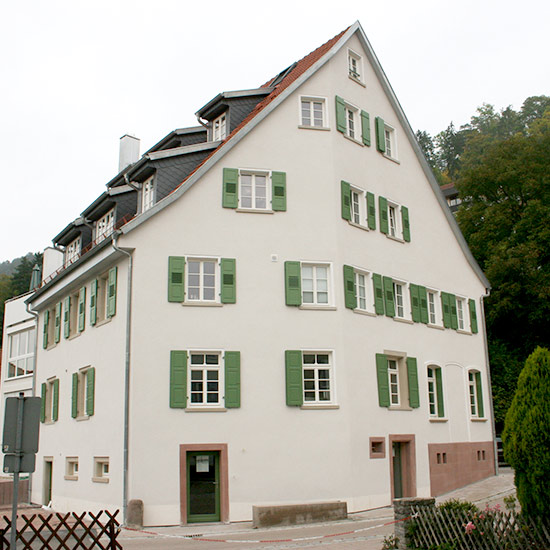
In December 2012, the house in Dr.-Abraham-Schweizer-Platz in Horb was opened as a historical, educational and memorial centre. Until November 10th, 1938, the Jewish community gathered here for prayer. Opposite to it is the home of Rabbi Dr. Abraham Schweizer who was in charge of the largest rabbinate in Württemberg areawise. Exhibitions and events provide information on the former rabbinate and the Jewish community of Horb. The Jewish Prayer Room serves as a place of tolerance, inter-religious and inter-cultural dialogue.
"Synagogue" Horb
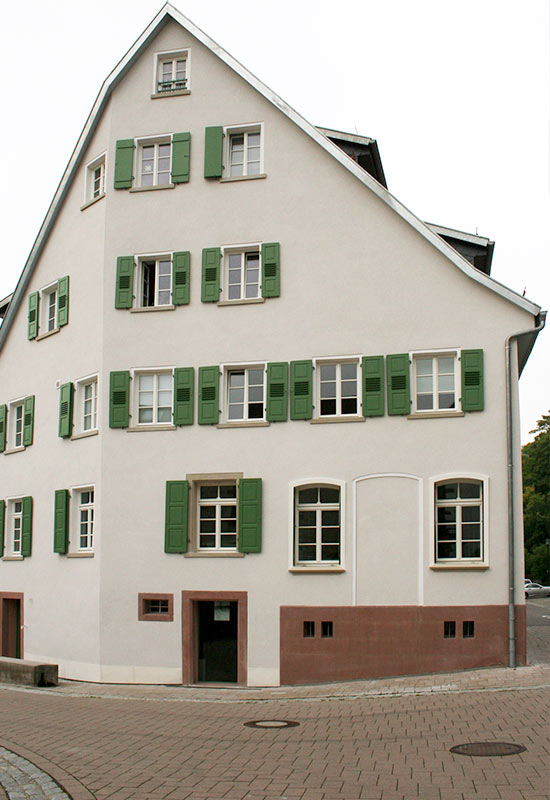
When the older inhabitants in Horb speak of the “synagogue” they mean the former Prayer Room of the Jewish community in Horb. From the end of the 19th century up to the time of its defilement in November 1938, it was in a house near Ihlinger Gate on the old road to Ihlingen. Today the house is renovated and the Prayer Room on the ground floor is now a memorial site and a small museum. The owner is the Support Foundation of the Jewish Prayer Room in Horb under the umbrella of the Association of Patrons and Friends of the Former Rexingen Synagogue. The upper floors of the house are resided in as was formerly the case.
Year of construction unknown
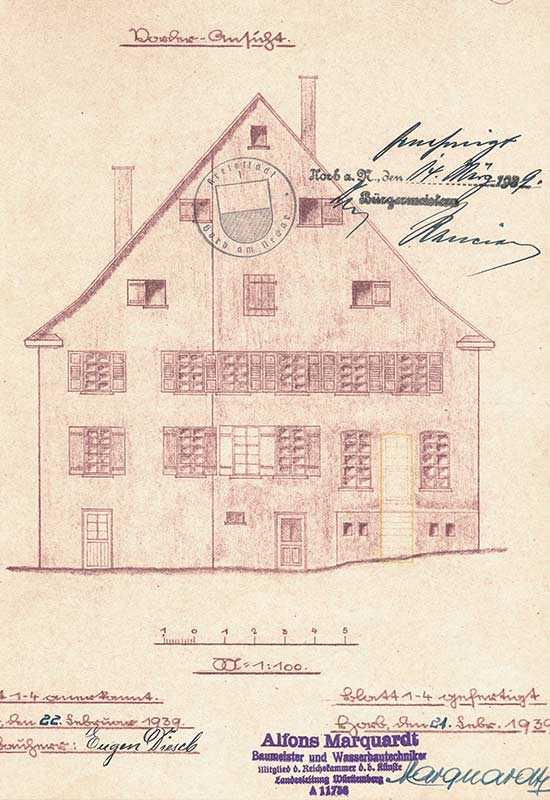
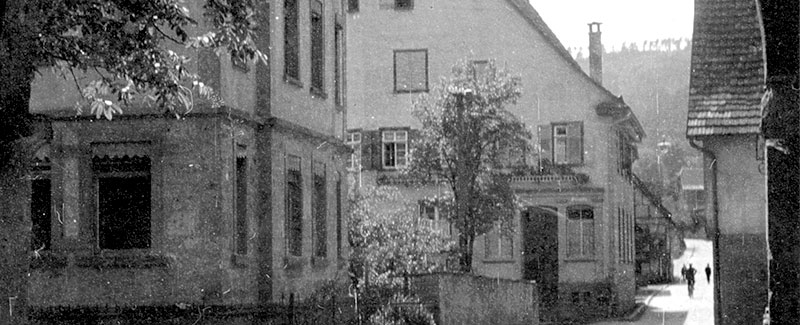
The year of construction of the house with the distinctive facade in Fürstabt-Gerbert-Straße 2 is unknown. Originally it was probably built as a barn and underwent many alterations and uses. It was waggoner’s house, restaurant, Prayer Room of the Jewish community, and after 1939 it was used purely as a residential building.
During its use as Prayer Room the two large rooms on the raised ground floor served as men’s and women’s sections respectively, joined by a passage.
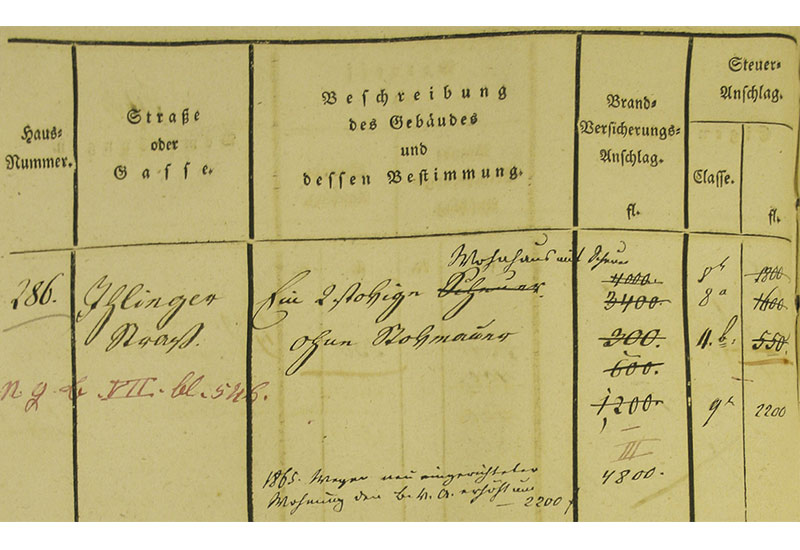
The oldest document found to date is a fire insurance record. The first entry is dated 1829. The building is described as “a two-storey residential building with a barn”. Further entries testify to alternating owners and uses. In 1849 it was destroyed by fire and immediately rebuilt.
Multiple uses
In 1865 Christian Blocher built an apartment on the first floor. In 1866 the “cargo waggoner” Josef Blocher took over the house. On the ground floor was the horses’ stable with four boxes, and behind that was a cowshed. The right half of the house was a threshing floor which extended right up to the second floor. On the left half of the first floor there were two rooms and on the second floor was an apartment with kitchen, bedroom and two small rooms. Further alterations took place and the threshing area was converted into rooms.
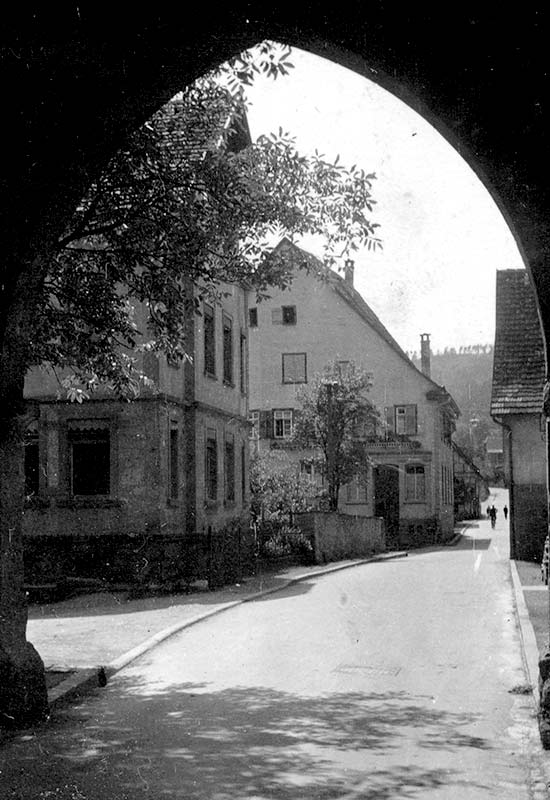
The house had two entrances, one through the stable and another above the outside steps leading directly to the first floor which at one stage contained the restaurant ‘Gasthaus zum Löwen’.
In 1890 it was owned by Simon Schwarz the cattle-dealer, who rented out the two lounges to the Jewish community as Prayer Room. It continued in the hands of the Schwarz family until, in 1930, Rudolf Schwarz sold it to a Christian family named Diesch. The lease to the Jewish community continued to exist. Rudolf Schwarz and his wife emigrated to Holland in 1934.
The equipment inside the Prayer Room was basic. On the eastern wall in the men’s section was the Torah shrine and in front of that the lectern. Both men and women sat on plain chairs, the children on benches along the wall. In the stable below were Rudolf Schwarz’s cows.
Memories of Fritz Frank
A vivid description of the rooms and religious services is found in the childhood memories of Fritz Frank who was born in Horb in 1886:
“This small Jewish community consisting of 30 families possessed nothing comparable in size or beauty to a church. Their synagogue is nothing more than two rooms, one opening out on the other, above the stable of Schwarz the cattle-dealer. The moo of the cows blends in with the service which in no way disturbs those praying who have grown up with the cattle, so to speak. In fact they hardly notice it. In the men’s room there is a cupboard with the Torah scroll on the eastern wall, the lectern draped in velvet and ten rows of chairs. To the right and left of the lectern is a narrow bench for the children who can be watched in this way and don’t cause disturbance.
Beside this is the women’s room from which a passage as wide as a door gives a clear view of the lectern, the prayer leader and the Torah shrine. Plain rows of chairs are the only equipment here. The bareness and humbleness do not diminish the solemnity of the services.
Sounds of life from the street penetrate the Prayer Room and are no more a distraction than the stable noises, consisting as they do of the shouts of women and children, of farmers’ cartloads or the doctor’s vehicle. Those praying would recognize each sound, that is, if they paid any attention to it.
Each member of the community has his own place. Should illness or travel prevent one from attending, his place remains empty and is thus a form of participation in the service. Although the older generation still understand the Hebrew prayers, they are only partly aware of the content as they pray. On the whole they content themselves with observing the ritual, the silent movement of the lips, standing, bowing, singing the “Nigun”, in unison with the prayer leader or singing alternately with him.
It is not so important to understand every word. God gave us the Bible in his language and He understands. Not the person, but rather the word and the melody speak to God, while the prayer shawl donned with a blessing, elevates the physical and the everyday which become a sacerdotal vessel. The person at the lectern is no longer little Lippmann Stern the tailor who, during the week, sleeveless and cross-legged, sits on his shop counter sewing, calling in a customer, frightening or attracting children. No! He who now stands before all, wrapped from head to foot in the white shawl with black stripes and frayed edges, is really a member of a people of priests representing the Jewish people according to God’s plan. When he calls out for the Torah and those called upon take out the Torah and carry it solemnly around the lectern; when those standing around touch the Torah with their fingertips which they then kiss ( the children, too, imitate this sign of veneration without understanding a word); when the community sings: adonai adonai el rachum we anun ( our God, our God, merciful and kind ); and when they bring back the Torah singing “It is a fountain of life and whosoever holds on to it, whosoever grasps it, will be happy. Its ways are the ways of grace. All its paths are peaceful”, each one sings joyfully, as well and as beautifully as he can, with conviction and the wish that his song may be pleasing to God.”
Destruction of the Beetsaal
On the morning of November 10th 1938, SA men and pupils of the Secondary School in Horb led by their teacher and Hitler Youth leader Franz Gronmayer forced their way into the prayer Room. They threw the Torah scroll, prayer books, candlesticks and furnishings out into the street, trampled on them and set them on fire.
Renovation and current use
After the defilement of the Prayer Room the owners had the two rooms converted into apartments for rental. The outside steps were torn down and the upper entrance was walled up.
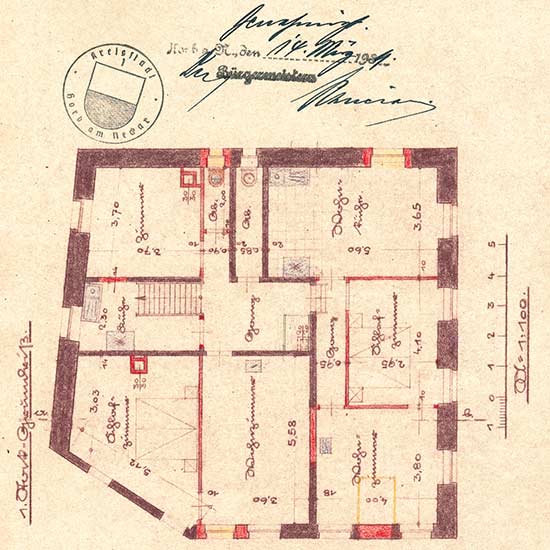
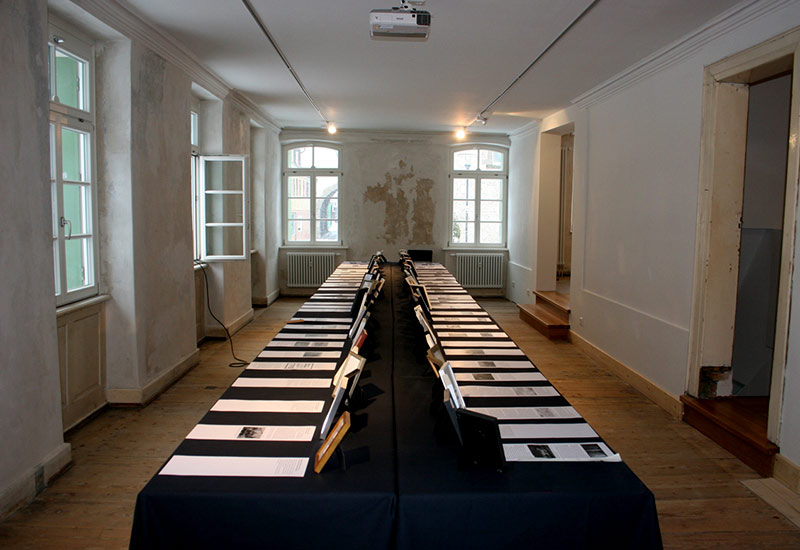
After the death of the last owner, the protected historical building was put up for sale and was finally bought by a group in joint ownership who had it renovated and altered. One of the new owners is the Support Foundation of the Jewish Prayer Room which has been using the two lower floors for exhibitions since 2012.
Preservation of the building
When the empty house under protection as a historical monument was up for sale in 2004, members of the Association of Patrons and Friends of the Former Rexingen Synagogue decided to buy it in order to ensure its use as a memorial site and museum of the history of the rabbinate. The dilapidated building was in great danger of being torn down or of serving a purpose in no way appropriate to its historical significance.
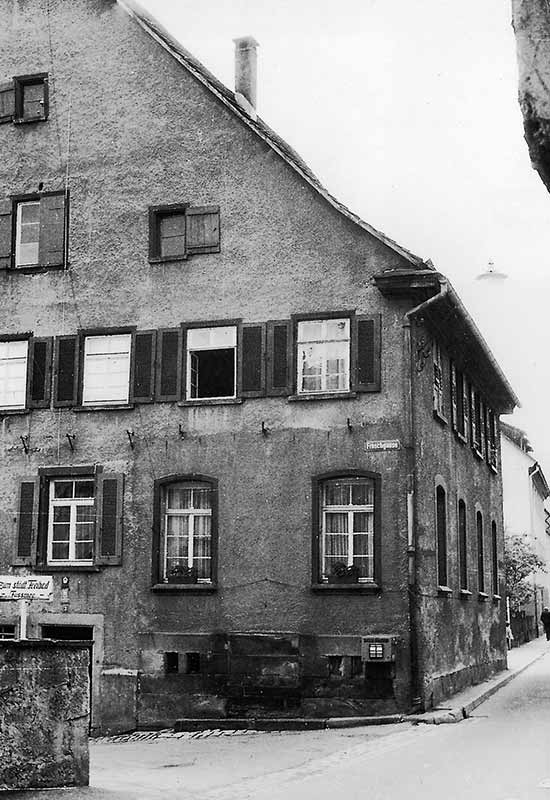
In 2006 a Support Organization was founded. Its aim was to collect money for the purchase of the ground floor and first floor of the building and to have them renovated with the assistance of subsidies for redevelopment offered by both the town and the federal state. The building was divided as follows: on the upper three floors new modern apartments were created and were bought by friends of the Support Foundation.
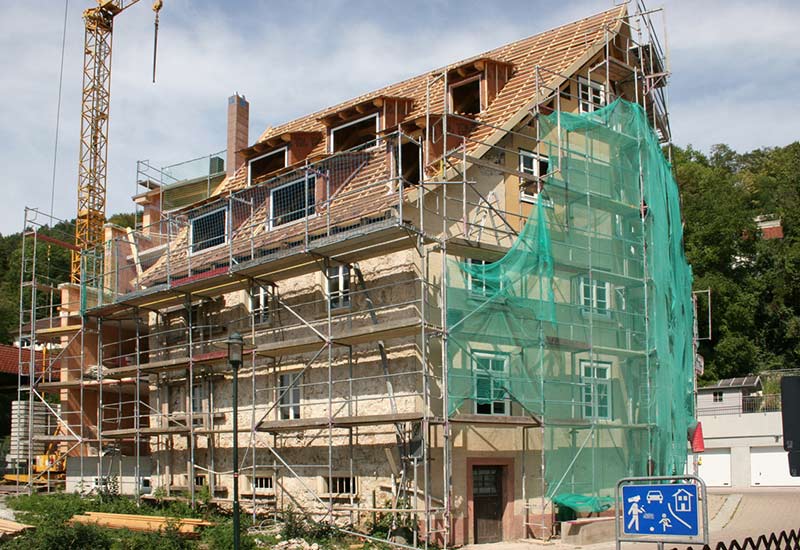
Together with the State Department for the Protection of Historical Monuments the Foundation applied a discreet renovation concept by which only that which absolutely required renewal was renewed. In this way the original worn floorboards, the old walls with cracks and traces of colour and an original window could be preserved. Damage in the moulding bears witness to the insertion of walls when the then owners of the house converted the two rooms into two apartments after the defilement of the Prayer Room in 1939.
Use as Museum and Documentation Centre
The purchase of the former Prayer Room and old stable and cellar in the basement enabled the Association to document the history of Swabian rural Judaism in the region. The municipal area of Horb contains six Jewish cemeteries: Horb, Mühlen, Mühringen, Nordstetten, Dettensee and Rexingen. There were Jewish communities in all of these places, each with its own synagogue. The rabbinate district was the largest in Württemberg in the 19th century and extended from Tübingen to Rottweil. The seat of the rabbi from 1728 to 1911 was in Mühringen and was moved to Horb in 1913. The community in Mühringen had greatly decreased unlike the community in Horb which, although only dating from the mid-19th century, had grown rapidly.
Today the rooms are used for alternating exhibitions. The first entitled “The neighbours are being taken away” took place in December 2012. It depicted the deportation of Jewish families and plundering of their homes in Rexingen, Horb, Nordstetten and Mühringen. In April 2013, the exhibition “Place of Refuge and Promise: Shavei Zion” was launched.

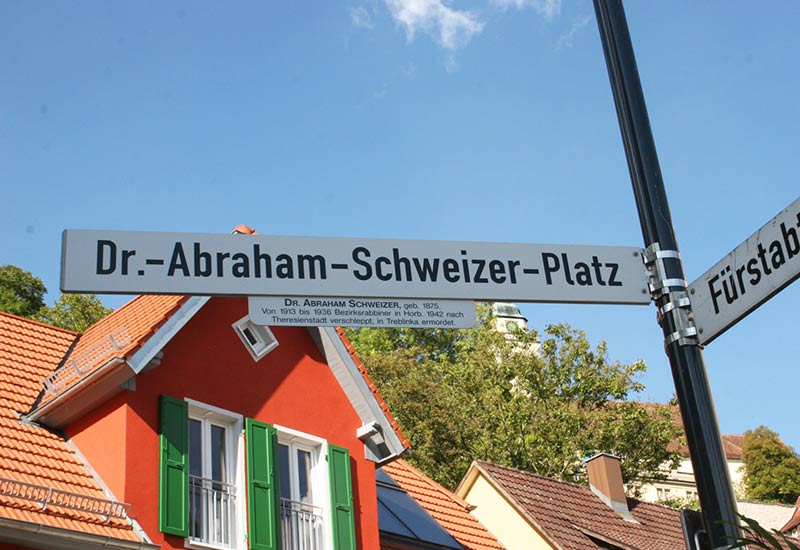
Directly in front of Fürst-Gerbert-Straße 2 (house containing the Prayer Room) is a special place of remembrance. In 2011 the Square was officially named after the last rabbi of Horb, Dr. Abraham Schweizer, who was murdered in Treblinka in 1942.