Jewish Families Database
Bridges and friendships
Join in
We look forward to exchanging ideas with other researchers of Jewish history and supporting descendants of former Jewish citizens in their search for ancestors and relatives. Please contact us personally to request access.
Get to know
The Jewish Families Database Project introduces itself
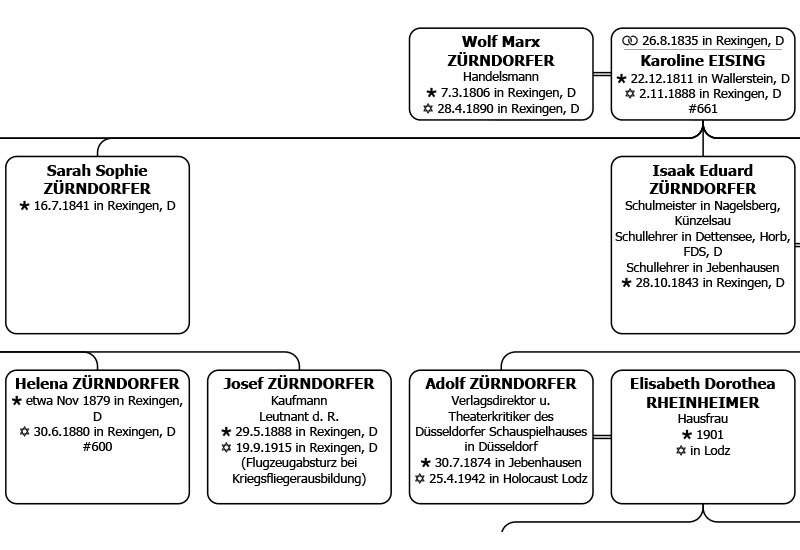
Family trees show the branches and origins of families across generations. This allows for vivid depiction of family relationships. Our family database is intended to help Jewish families around the world reconstruct their roots. It can also help facilitate the search for relatives.
The family database helps build new bridges and friendships by organizing encounters between people from Israel, America, and Germany. This way, visitors from all over the world can be helped to gain a picture of the lives of their ancestors in Germany through archival documents or family tree lists.
Numbers and data
| People | > 100.000 |
| Families | > 35.000 |
| Media Sources | 5.800 |
| Locations | > 20.000 |
| Sources | > 2.100 |
| Cemeteries | > 40 |
| Users | > 230 |
Top surnames
Additional family information
Further information about individual families also exists in the form of:
- Documentation
- Family legacies
- Photos
- Stories
- Biographies
- References to literature
- Archives
- Research results
- Family trees and much more.
Data protection
Data and content relating to living individuals are protected and will only be shared with the consent of those affected. Extracts can be made available in the form of GEDCOM files, family tree diagrams, or lists upon request.
Konzeption einer jüdischen Familiendatenbank
Descendants of former Jewish citizens repeatedly came to Rexingen to visit the local cemetery or the former homes of their ancestors. By 2012, the association had painstakingly compiled family trees for the respective families and assigned them grave numbers. The project manager recognized that a database-driven solution could offer a wide range of possibilities. Over a three-year research period, she designed a genealogical knowledge database for Jewish families based on the civil status registers from the holdings of the Stuttgart Main State Archives J386 and the local registry office records. The following framework conditions were adapted in the software accordingly:
- Adapting the database structure to the specific requirements of Jewish family research, with the creation of individual database fields for evaluating deportations, Stolpersteine (stumbling blocks), gravestones, grave numbers, participation in WWI, WWII, membership, etc.
- Differentiated user permissions to ensure data protection.
- Multilingual system to enable international use.
When entering personal data (birth, death, marriage), many other biographical events (occupation, place of residence, education, emigration, etc.) were also recorded to support them with documents, images, and media. It quickly became apparent how the Jewish families were connected across regions. People married, moved, or established professional connections in Baisingen, Tübingen, Haigerloch, Hechingen, Rottweil, Breisach, Alsace, the USA, and Israel.
Ausbau der jüdischen Familiendatenbank für Südwestdeutschland des Gedenkstättenverbund GNA
After successfully entering all personal data, it became apparent that a large number of individuals from other locations with former Jewish communities were also included. At the annual meeting of the Baden-Württemberg Memorial Sites in Bad Urach in March 2015, the database's concept also impressed other memorial sites (Braunsbach, Breisach, Villingen). They joined the project to use the database as a genealogical knowledge database and to sustainably archive their research results cost-effectively. Additional member initiatives from the Gäu Neckar Alb Memorial Sites Association joined (Tübingen, Haigerloch, Hechingen, Baisingen, Horb, Rottweil, Alsace), bringing the number of registered individuals to over 29,000.
Ausbau der Öffentlichkeitsarbeit für Erhöhung des weltweiten Bekanntheitsgrads mit Vorträgen
In 2022, we now have over 100,000 Jewish individuals with roots in southwest Germany in the database: from Germany, Great Britain, France, Switzerland, Austria, Israel, South America, and the United States. To further raise awareness of the "Jewish Family Database" project regionally and internationally, expanding our public relations efforts is important. The project has therefore been presented at various events, and collaboration has been sought. We welcome further research groups who would like to contribute their findings to the database.